Policy, Planning, Organisation and Responsibilities
Policy
General Statement of Intent
SHS collectively recognises and will endeavour to exceed the requirements of its legal obligations under the Health and Safety at Work etc Act 1974 (HSWA 74), and associated regulations so far as is reasonably practicable, to ensure the health, safety and welfare at work of all persons who may be affected by its undertakings. This will be achieved by senior management taking responsibility for and committing resources to meet the management plans and H&S objectives defined by the company to ensure the success of this policy and continual improvement. In particular the company recognises specific duties under the Health and Safety at Work etc Act 1974 and will ensure:
- Activities are subjected to risk assessment to effectively control risks.
- The provision and maintenance of ‘Equipment’ and ‘safe systems of work’ are safe and without additional risks to health.
- The use, handling, storage and transport of articles, substances and people is safe and without undue risks to health.
- All workplaces and training facilities will have adequate welfare facilities, workplaces and working environments, including access and egress which are kept in a safe condition and do not pose a risk to health.
- There is sufficient information, instruction, training and supervision in order to ensure all employees are competent and can carry out their jobs safely and without risks to their health at work.
- There is consultation and liaison with relevant persons, contractors and organisations including employees’ on health and safety matters.
- The effective implementation, monitoring, and review of this policy regularly as appropriate.
‘Health and Safety does not happen by accident – it is everybody’s responsibility’
The company cannot ensure your health and safety alone and because Health and Safety does not happen by accident – it is everybody’s responsibility, the company expects all employees and visitors to cooperate with the company to meet the terms of this policy and its associated arrangements and to act responsibly and not to misuse anything provided for them in the interests of everyone’s health and safety.
All visitors and staff are particularly requested to notify the Chief Instructor of any incidents / accidents or situations that could pose a risk to health and safety.
General Information
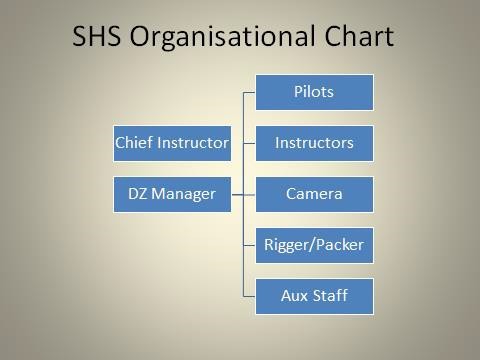
SHS provides instruction and facilities for the sport of skydiving, aircraft operations, general drop zone operations/ management and associated administrative duties. The management structure comprises a Chief Instructor and DZ Manager, and utilises closely vetted instructors and pilots for service delivery.
The Registered head quarters are located at:
Sky-High Skydiving
Shotton Airfield
Shotton Colliery
Co Durham
DH6 2NH
Health and safety system structure
The company’s health and safety system comprises of 3 parts or levels;
| Levels | Component | 18001 correspondence | Location |
|---|---|---|---|
| 1 | Describes the General Statement of Intent, Organisation and Responsibilities for Health and Safety. | Planning, Implementation and operation Checking and corrective Action Review | Within this manual Part 1 & 2 |
| 2 | Addresses risk assessment and operational and management control | Planning, evaluation of compliance Operational control. | Within this manual Part 3 |
| 3 | Contains workplace instructions | Operational Control | Displayed within the workplace |
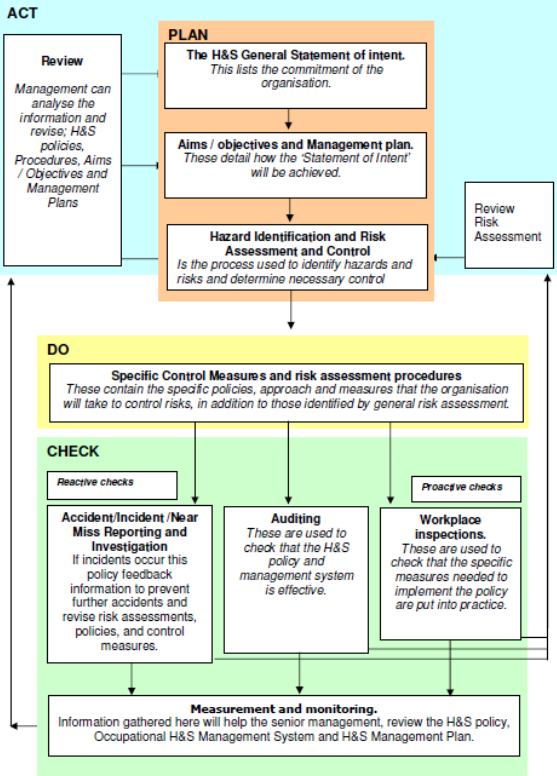
The system is based around the plan – do – check – act principles of management and the methodology of ‘ISO BSI 18001:2007 Occupational Health and Safety Management Systems – Requirements’.
H&S Manual Control and Maintenance
The maintenance of this Manual is the ultimate responsibility of the Policy Signatory. Day to Day maintenance of this Manual is delegated to the Chief Instructor. Controlled distribution of copies of this manual to named individuals and for issuing amendment instructions is the responsibility of the Chief Instructor. Any person discovering the need or potential need for a change to this Manual should notify the Chief Instructor.
How to Use Manual
The diagram below shows the process that this H&S management system uses to assess and control risks.
Planning
Planning
The Policy signatory will determine with appropriate consultation objectives and plans to ensure that the H&S policy and management system are effective.
The Chief Instructor will ensure effective planning for operational risk control on a day to day basis by the application of the risk assessment and inspection regime.
Aims/Objectives and management programme
Aims and objectives and management programmes will be determined / authorised at the annual review meeting as agreed by the management team.
These objectives will be;
- Specific, Measurable, Achievable, Realistic, and Time bound,
- Focus on ill health as well as safety,
- Compliant with legal requirements, and
- Be committed to continual improvement.
Aims
The aim of the H&S Management system is;
‘To effectively control Health and Safety risks to minimise accidents and injuries’.
Objectives
This aim will be met by meeting the following objectives;
| Objective | Target Date | Measure |
|---|---|---|
| Reduce hazards and/or risks to the Parachute Landing Area (PLA) | Reduction in marked miscellaneous objects and foliage on the PLA | |
| Continually improve our health and safety performance by increasing incident and near miss reporting and share lessons learnt to all H&S personnel working at SHS | Increase in logged/shared incidents/accidents | |
| Raise employee, contractor and customer Health and Safety awareness by promoting SHS’s Health and Safety management practices, and provide information to aid consultation with all those interested in the Health and Safety policies, plans and performance of the Company. | Increased signage, information transparency and availability throughout the centre. | |
| Provide suitable and relevant health and safety training to employees, contractors, customers and any other personnel involved in parachute related activities at DTVA (including ground based activities), so that each individual can safely carry out their responsibilities. | 100% of Employees and 100% of customers are to have signed and filed membership rules relevant to each person and the activities that they will be involved in. | |
| To comply with statutory requirements and strive to exceed these where appropriate. | Approval by the BS following audit/ inspection. |
Application Legislation Register
The organisation complies with its legal Health and Safety requirements by compiling a list of applicable legislation which it makes reference to within risk assessments, which the Chief Instructor reviews by referring to the Health and Safety Executives Website. www.hse.gov.uk
Any amendments identified which require the updating of this policy manual, arrangements or risk assessments will be communicated by the Chief Instructor to staff and the board as necessary.
| Legislation | Relevance | Last Review |
| The Health and Safety at Work Act 1974 | All. | |
| Safety Representatives and Safety Committee Regulations (SRSCR) 1977 | Consultation where there is trade union involvement | |
| The Health and Safety (Consultation with Employees) Regulations (HSCER) 1996 | Consultation where there is no trade union involvement | |
| Health and Safety (First Aid) Regulations 1981 | All. | |
| Electricity at Work Regulations 1989 | Electrical appliances and systems | |
| Health and Safety Information for Employees Regulations (HSIER) 1989 | Work Premises, H&S poster | |
| Manual Handling Operations Regulations 1992 | Any moving of items requiring bodily force. | |
| Personal Protective Equipment at Work Regulations 1992 | Any work where significant risk can be reduced by PPE | |
| Workplace (Health, Safety and Welfare) Regulations 1992 | Any internal workplace | |
| Health and Safety (Display Screen Equipment) Regulations 1992 | Work involving Display Screens | |
| Reporting of Injuries, Diseases and Dangerous Occurrences Regulations (RIDDOR) 1995 | Accidents | |
| Health and Safety (Safety Signs and Signals) Regulations 1996 | Anything where significant risk can be reduced by signage | |
| Regulatory Reform (Fire Safety) Order (RRFSO) 2005 | Workplaces- Fire risk | |
| Provision and Use of Work Equipment Regulations (PUWER) 1998 | Work equipment | |
| Management of Health and Safety at Work Regulations (MHSWR) 1999 | All | |
| Control of Substances Hazardous to Health (COSHH) 2002 | Substances, dusts, liquids, fumes, gases | |
| Dangerous Substances and Explosive Atmospheres Regulations (DSEAR) 2002 | Flammable substances | |
| Employers’ Liability (Compulsory Insurance) Act 1969 | Provision of employers liability insurance | |
| The Work at Height Regulations 2005 | Work at height | |
| Construction (Design and Management) Regulations 2007. | Contractor and construction activities | |
| Environmental Protection Act 1990 | Effects on the environment |
Implementation and Operation
The organisation will ensure documentation exists where necessary to demonstrate conformance to a Health and Safety Management System or legislative requirements. Such documents will be listed below.
The Chief Instructor / Dropzone Manager is responsible for;
- Ensuring all documentation is marked with an identifier.
- Ensuring the list below is up to date with current documents.
- Ensuring current documents are available to staff.
| Document / record name and purpose | Issuer | Issue date | Previous issue |
| Health and Safety Manual | |||
| Risk assessment form | |||
| SMS Proactive Form | |||
| SMS Reactive Form | |||
| SMS Routine Form | |||
| H&S Suggestion Form | |||
| Accident/Incident Book | |||
Management Structure
Communication, participation and consultation.
Communication
With reference to the Management Structure at (4.2), direct lines of communication are available for Health and Safety matters in addition to the normal line management links.
• The minutes of all H&S meetings will also be made available on the notice board.
Consultation
Effective consultation will be achieved by the organisation consulting with employees and visitors as appropriate when risk assessments are carried out and changes that may affect employees may be expected.
Participation
Participation in matters pertaining to Occupational Health and Safety will be achieved by visitors and staff being encouraged to complete near miss forms, participate in accident investigations and where possible assist with risk assessment
General Responsibilities
In addition to those general responsibilities listed below specific responsibilities are listed throughout this manual.
Policy Signatory.
The Policy Signatory is responsible for;
- Ensure that objectives and management plans are put in place to ensure this policy is effective and to enable continuous improvement.
- Establishing the Company Safety Policy and Instructions and for ensuring that they are documented, authorised, understood and implemented by all employees under their control.
- The appointment of competent persons to carry out the Health and Safety responsibilities as delegated.
- Ensuring all areas and processes of the business are subject to Risk Assessment and control.
- Ensuring effective consultation with the workforce and other stakeholders.
- Ensuring the management review takes place at least once per year.
- Allocating sufficient resources, authority, and responsibility to the Networks Managers to allow effective operational risk control and meet legal duties.
Instructors
Management have responsibility to ensure that;
- The people they are responsible for are aware of, understand and comply with the Organisations Health and Safety Policy and its requirements.
- They cooperate with the policy signatory to achieve effective implementation of the organisations policy.
The Chief Instructor is responsible for;
- Meeting the requirements of the manual (part 3) where there is a requirement placed on the organisation or management.
- Ensuring effective planning for operational risk control on a day to day basis by the application of the risk assessment and inspection regime.
Employees
It is a legal requirement under the Health and Safety at Work etc Act 1974 that all employees
at work have a duty to;
- Co-operate with their employer,
- familiarise themselves with and to comply with the requirements of this Manual,
- Use protective equipment as instructed and as intended, and ensure its safe-keeping
and to report any defects or failures. - Use work equipment and facilities as instructed, safely, efficiently and with respect for
property and the welfare of others. - Ensure that their acts and omissions do not affect the health and safety of others.
Appointed Persons
It is a legal requirement under the Health and Safety at Work etc Act 1974 that all employees
at work have a duty to;
- Co-operate with their employer,
- familiarise themselves with and to comply with the requirements of this Manual,
- Use protective equipment as instructed and as intended, and ensure its safe-keeping
and to report any defects or failures. - Use work equipment and facilities as instructed, safely, efficiently and with respect for
property and the welfare of others. - Ensure that their acts and omissions do not affect the health and safety of others.
Visitors
All visitors are expected o cooperate with the organisation by complying with the Health and Safety requirements and instructions given to them by representatives of the organisation.
Checking/Corrective Action and Review
Measuring and Monitoring.
The measuring and monitoring of the effectiveness of this manual will be carried out as defined above in ‘aims and objectives’.
It is the Chief Instructors responsibility to gather, analyse and present this data to the review meeting.
System Audits
The Chief Instructor is responsible for ensuring that each element of the Health and Safety System is subjected to audit by a competent person at least on a regular basis. The competent person(s) selected shall be independent of the day to day implementation of the Health and Safety system.
Non conformity and Corrective Action
Corrective actions will be identified within the planning and checking processes i.e.
- Planning – risk assessment.
- Checking – inspections, investigations, near miss reporting, accident reports and audits.
Any requirement for corrective action will be recorded on the appropriate form which will then be subject to a target completion date and implementation by an actioned person to ensure closure.
Management Review.
To enable effective corrective action to be determined following the measuring and monitoring of the health and safety management system and system audits, this manual and related procedures shall be reviewed at least once every year.
The responsibility for this review lies with the Policy Signatory.
The results of this review, will result in the allocation of actions and target completion dates which shall be recorded in conformance to the Document and Record Control procedure
The Health and Safety Management System Review shall include the following minimum agenda.
- Review of actions arising from the last review meeting.
- Review of any enforcement action.
- Review of the adequacy of the Company H&S Policy concerning the organisations undertakings and the current legal requirements.
- Review of the adequacy of the Policy and Documented System for Health and Safety, including analysis of measurements relating to aims and objectives.
- A review of the Risk Assessment Register to determine whether any Risk Assessments should be re visited.
- Presentation of the analysis of sickness and accident records and any consequential actions.
- Review of any external and internal Safety audits, inspections or investigations.
Any other business.
Risk Assessment, and Operational Control and Arrangements
Hazard, Aspect Identification, Risk Assessment and control
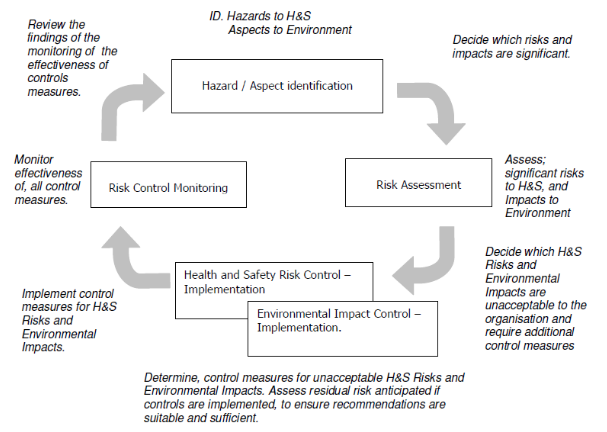
To enable effective risk control and legal compliance the organisation will identify and risk assess significant hazards and environmental aspects within the scope of the organisation’s undertaking that it has the ability to influence, and implement control measures as far as is reasonably practicable to mitigate those risks with respect to employees and non employees, (including but not limited to – young persons, pregnant women and nursing mothers), and use the best available techniques to reduce impacts on the environment.
Regulatory Reference
The Health and Safety at Work etc Act 1974 Environmental Protection Act 1990
Management of Health and Safety at Work Regulations 1999
Associated Documents and Procedures
Risk / impacts assessment register Risk assessment form
SMS Proactive/Reactive/Routine H&S Suggestion Form
Accident report Form
Environmental aspects and impacts Evaluation form
Requirement
The organisation will;
- Ensure competent persons are used to ensure the successful application of this procedure by providing adequate resources, training and/or external competent advice.
Hazard/Aspect identification
In order to successfully identify all significant hazards the organisation will;
- Create an asset register of all activities, plant, equipment and substances and where necessary carry out risk assessment.
- Create an asset register of all environmental aspects, and where necessary carry out environmental risk assessments.
- Carry out inspections of workplaces to establish unsafe conditions and unsafe actions and shortcomings in environmental management.
Employees and visitors will;
- Inform the Instructors of significant hazards / risks and shortcomings in environmental management verbally, and
- Complete the appropriate Incident report forms, and accident report forms, and
- Cooperate with the completion of risk assessments.
Risk Assessment
In order to carry out a suitable and sufficient risk assessment the organisation will;
- Carry out risk assessments of the significant hazards / environmental aspects identified to ensure that all significant risks and environmental impacts, and associated existing workplace precautions are identified.
- Ensure that risk assessments cover particular groups at risk such as employees and non- employees, young persons, pregnant or nursing mothers, vulnerable persons including those with learning difficulties and address fire risks.
- Ensure that risk assessment covers routine and non-routine activities, and environmental risk assessments cover normal, abnormal and emergency situations.
- Refer to statutory legislative requirements, Accepted Codes of Practice and best practice.
- Ensure that risk assessments identify and meet the requirements of all the aspects detailed within this policy manual. (NB particularly to aspects identified within Part 3 of the manual).
- Ensure that risk assessments determine whether existing risks, impacts are tolerable or not.
- Review assessments regularly and within the timescales defined therein.
- Analyse incidents, near miss (es), accident reports and investigations to ensure risk assessments are kept up to date.
Health and Safety Risk Control – Implementation
The organisation will;
- As a result of risk assessment (whether documented or not) ensure so far as is reasonably practicable the implementation of measures so as to reduce the risks to health and safety to an acceptable level.
- As a result of risk assessment (whether documented or not) reduce environmental impacts using Best Available Techniques that result in appropriate environmental control measures.
Risk Control Monitoring
The organisation will;
- Monitor the effectiveness of its control measures by day-to-day visual monitoring by the Instructors pilots and other employees, and regular workplace inspections.
Accident/Incident/Near Miss Reporting and Investigation
Despite the good intentions of the organisation it is inevitable that some incidents will happen. Therefore the organisation aims to capture this information analyse it and use it proactively to review risk assessments and implement corrective action to prevent further injury and ill-health.
Regulatory Reference
Reporting of Injuries, Diseases and Dangerous Occurrences Regulations 1995
Health and Safety (First Aid) Regulations 1981.
Associated Documents and Procedures
Accident Report and Investigation Form (internal)
Report Form
Requirement
The organisation will;
- Record all incidents (and dangerous occurrences), using the Accident Report and Investigation form.
Non-externally reportable incidents
- Incidents that are not externally reportable will result in immediate corrective action where possible to prevent further occurrence, which will be recorded on the report form.
Externally reportable incidents
- Any incidents that are reportable to the enforcing authority will be externally reported as soon as possible. (ref – http://www.hse.gov.uk/riddor/guidance.htm )
- Externally reportable incidents will result in a full accident investigation to determine longer term corrective action, as well as immediate corrective action where possible, which will be recorded on the form.
Employees and visitors will;
- Report all incidents and dangerous occurrences to an organisational representative
Emergency Preparedness and Response
To prevent serious and imminent danger arising from emergencies the organisation will identify and reduce these risks as far as reasonably practicable through the risk assessment process.
Regulatory Reference
Health and Safety at Work etc, Act 1974
Management of Health and Safety at Work Regulations 1999.
Health and Safety (Safety Signs and Signals) Regulations 1996
Regulatory Reform (Fire Safety) Order (RRFSO) 2005
Health and Safety (First Aid) Regulations 1981
Procedural Reference
Fire Action notices.
Requirement
Fire Emergencies
The organisation will as a result of the risk assessment process and where reasonably
practicable provide and maintain;
- Fire detection systems to give early warning of fires,
- Emergency escape routes, and means of final escape that are also appropriately signed,
- Emergency lighting and fire fighting equipment to enable escape and tackle
controllable fires, - Systems to summon the emergency services.
- A system to ensure the building has been fully evacuated.
- Adequate training to minimise risks from fire.
- Notices displayed strategically to notify visitors and staff of emergency procedures.
Employees and visitors will;
- Comply with the Fire Action Notices, and not misuse equipment and signs provided to ensure the safety of staff and visitors.
Injury Emergencies
The organisation will,
- Maintain first aid supplies, and provide a means of summoning the emergency services.
- Ensure that staff have sufficient training to fulfil the roles of appointed persons, i.e. summon assistance and maintain the situation until the emergency services arrive.
Safety Signage and notices
Where there are remaining risks that cannot be sufficiently controlled by other methods then the organisation shall provide Health and Safety signage as a result of the risk assessment process.
Regulatory Reference
Health and Safety (Safety Signs and Signals) Regulations 1996.
Associated Documents and Procedures
None
Requirement
The organisation as part of its risk assessment process will where risks cannot be acceptably
controlled in other ways;
- Provide warning signs where there are unacceptable risks. i.e. ‘caution slippery floors’,
- Provide mandatory signs where particular action(s) are required to mitigate risks, i.e. ‘fire action notices,’ ‘fire exit keep clear’ etc.
- Provide safe condition signs where there is a need to signify safe areas and routes etc, i.e. fire escape routes, and fire exits,
- Provide prohibition signs where a particular action may result in direct risks to safety. i.e. ‘no smoking’
- Provide fire safety signs to indicate; where ‘fire fighting equipment’ is, and ‘fire call points’ etc,
- Ensure safety signs conform to the requirements of BS 5378 (1980). i.e. include a pictogram, comply with appropriate colours, and are the relevant style.
Employees and visitors will;
- Comply with safety signage.
Personal Protective Equipment (PPE)
As part of the risk assessment process where it is identified that the only way risks can be suitably controlled is by the use of personal protective equipment, suitable equipment will be provided and maintained.
Regulatory Reference
Personal Protective Equipment at Work Regulations 1992
Associated Documents and Procedures
None
Requirement
The organisation will as a result of the risk assessment process and as a last resort to ensure
health and safety;
- Provide, maintain and store suitable Personal Protective Equipment where required, free of charge and with instructions for its safe use. i.e. ear defenders for use by those who are required to be in a noisy environment.
Employees will;
- Use all Personal Protective Equipment in the manner it is designed for,
- Not misuse Personal Protective Equipment,
- Follow any instructions provided to enable the equipment to be used correctly,
- Report any faulty/damaged PPE to an organisational representative.
NB: failure of PPE is reportable under the Reporting of Injuries, Diseases and Dangerous Occurrences Regulations 1995.
Information, Instruction, Training and Supervision
The company will provide sufficient information, instruction, training and supervision to employees to ensure health and safety and where necessary to non-employees. Where visitors have special needs then extra supervision may be necessary to ensure safety.
Regulatory Reference
The Health and Safety at Work etc, Act 1974
Management of Health and Safety at Work Regulations 1999
Associated Documents and Procedures
None
Requirement
The organisation will where risk assessment as determined a need ensure;
- Staff have received adequate training and information to reduce risks to acceptable levels.
- Ensure until competent to do so, staff and visitors are supervised adequately to ensure safety,
- That where a deviation from a safe process is foreseeable to a degree which may result in injury or ill-health that documented procedures are in place. These may take the form of safety signage. This training may involve induction training, manual handling training, fire safety and emergency evacuation, first aid, chemical safety and other training as required.
Employees will,
- Not operate equipment, carry out activities or use substances if they are not competent
to do so, if in doubt ask! - Take heed of any training, information, or instructions provided.
Guidance
Where training is required to ensure safety in a specific activity it will address;
a. Risks associated with that activity.
b. Any safeguards and other protective devices provided.
c. Isolating equipment from energy sources, such as electricity, gas and compressed air.
d. The location and operation of operational controls.
e. The location and operation of safety controls.
f. Any safe systems of work / methods / or practises provided to alleviate risks
g. Any other apparatus or equipment provided to ensure Health and Safety.
h. Any safety signs provided.
i. Any Personal Protective Equipment provided.
j. The safe handling and use of substances, their associated hazards, risks, safe
practices and methods defined for dealing with emergency situations.
k. Any emergency procedures relevant to that duty.
Use of Work Equipment
In order to ensure that all work equipment is safe to use it will be subjected to risk assessment to identify and reduce risk as far as is reasonably practicable.
Regulatory Reference:
The Health and Safety at Work etc, Act 1974
Management of Health and Safety at Work Regulations 1999
Provision and Use of Work Equipment Regulations 1998
Procedural Reference
None
Requirement
The organisation will;
- Ensure that all work equipment including vehicles, parachutes and aeroplanes that are supplied / used are suitable and fit for purpose.
- Subject all plant and work equipment to risk assessment to ensure this policy is complied with,
- Ensure that suitable guards are used to control risks arising from mechanical hazards and suitable workplace precautions are taken to prevent injury from other hazards associated with machinery.
- Ensure work equipment is capable of being isolated from sources of power and bled of stored energy.
- Ensure work equipment is stable, has suitable controls and lighting and is adequately maintained.
- Ensure where there are specific risks from the operation of powered work equipment that only authorised and notified persons are allowed to operate it.
- Ensure that machinery which is faulty or out of service is marked with a sign ‘DO NOT USE’ and contains an authorised signature and is dated, and if necessary securely isolated from sources of energy.
Other organisational requirements repeated here for convenience are to;
- Ensure sufficient warning signs/notices, operating instructions, instruction, training, and
supervision is in place to reduce risks from work equipment to an acceptable level.
Employees will ensure;
- All work equipment is visually inspected before use to ensure it is safe to use, and not use any equipment they are not authorised to use.
- Notify management of any machinery which is faulty.
- Not use any machinery which is faulty or marked ‘DO NOT USE’.
Portable / Fixed Electrical Equipment / Installations
Through the risk assessment process the organisation will effectively control the risks from portable and fixed electrical equipment as far as possible by the purchasing, maintenance and proper use of appropriate equipment.
Regulatory Reference
Electricity at Work Regulations 1989
BS 7671: 2001 (IEE Wiring Regulations) as amended 2004
Provision and Use of Work Equipment Regulations (PUWER) 1998
Associated Documents and Procedures
None
Requirement
Employees will;
- Only use portable electrical equipment in compliance with operating instructions, and not consume fluids near electrical equipment where spillage could cause electrocution.
Portable electrical equipment
The organisation will as a result of risk assessment;
- Ensure all electrical equipment is suitable for its required use.
- Provide where ever possible battery operated equipment, or equipment designed to run from a centre tapped 110 volt supply, and ensure staff use it.
- Regularly subject portable electrical equipment to Portable Appliance Testing at appropriate intervals by a competent person and ensure that successfully tested equipment bears a sticker identifying its next test date. Equipment failing the test will be removed until subjected to a successful repair and test.
- Maintain records of electrical testing / inspection.
Fixed electrical installations
The organisation will as a result of risk assessment;
- Ensure all fixed wiring and installation is to the standard specified in the current IEE Wiring Regulations,
- Ensure all fixed electrical circuits that contain portable appliance sockets are protected by Residual Current Circuit Breakers or Devices.
- Ensure all circuits are capable of supporting anticipated load/conditions, and that all electrical equipment is supplied via adequate fusing, on/off controls and a means of securely locking off the electrical supply.
- Ensure that appropriate Warning Notices are prominently displayed where electrocution risks remain.
- Ensure that where possible all electrical work is carried out when the supply is securely locked off. Only the person carrying out the work can unsecure the supply after checking that it is safe to do so.
- Ensure that there is no ‘live working’ permitted on ‘live’ electrical circuits except where it is impossible to carry out the work on ‘dead’ equipment, and only where safety
- precautions have been carried out to ensure that risk to health and safety are kept to a minimum.
- Ensure that only competent trained and experienced electricians with appropriate qualifications and insurance are permitted to install, service or modify fixed wiring or services.
- Ensure that all fixed wiring is checked and approved by a competent person at least once every 10 years except for fire alarm system wiring which must be checked annually and documentation must be retained.
Manual Handling
As a result of the risk assessment process all manual handling will as far as reasonably possible be avoided, mechanised and any remaining risks will be reduced to as low a level as possible.
Regulatory Reference
Health and Safety At Work etc Act 1974
Management of Health and Safety at Work Regulations 1999
Manual Handling Operations Regulations 1992
Procedural Reference
None
Requirement
The organisation will as part of its risk assessment process as far as is reasonably practicable;
- Avoid manual handling,
- Provide mechanical lifting aids.
- Provide manual handling training to employees where applicable.
- Ensure products purchased have suitable handles and are kept below 15kg.
- Allow sufficient time to carry out manual handling activities safely.
Employees will;
- Try to assess the load, (i.e. determine its weight, centre of gravity, or other specific hazards).
- Plan the manual handling activity.
- Make sure that the load is within their capability.
- Make sure liquids that are carried do not splash about and that containers are secured.
- Not carry hot loads, unless appropriate gloves or other precautions enable this to be done safely.
- Make safe use of any lifting aids provided, including gloves.
- Ensure that handling the load will not put at risk them self or any other employee.
- Take notice of the environment and ensure adequate space, lighting and sure footing.
- Ensure that assistance is requested if required.
- Apply any manual handling training undertaken and lifting techniques to their job.
Control of Substances Hazardous to Health (COSHH)
There are some substances which the organisation may use which are a hazard to health, the company will ensure that where such chemicals exist, the risk assessment process is carried out to determine safe methods of handling and use to ensure health and safety.
Regulatory Reference
Control of Substances Hazardous to Health (COSHH) 2002
Procedural Reference
None
Requirement
The organisation will as part of its risk assessment process;
- As far as possible only use substances that pose insignificant risk to health, i.e. do not
have hazard warnings, and will not use personal protective equipment which contains
allergens (such as latex) which may affect persons which have notified the organisation
of their condition. - Ensure that all hazardous substances are supplied with manufacturer’s safety instructions,
and Material Safety Date Sheets (MSDS). - Ensure that MSDS’s are referred to and the actual use of the substance is considered to
determine safe methods of work. - Ensure that unless risk assessment determines otherwise that substances are used in
compliance with the manufacturer’s instructions. - Ensure where required for health and safety that appropriate personal protective
equipment such as safety glasses, latex free gloves and overalls are supplied and worn. - Ensure that all substances are kept in appropriate containers with suitable labels and
kept closed as far as possible. - Ensure where substances are used which can result in ill-health which can be detected
early by the use of health surveillance, such as for occupational dermatitis, that it is
carried out by a competent person.
Employees will;
- Comply with the organisations instructions for the safe use of substances, and ensure any
personal protective equipment and ventilation requirements are strictly adhered to. - Notify the organisation if they have any allergies, or health issues which may be
compounded by the use of substances, or protective equipment at work.
Control of Contractors and Other Visitors
The organisation will through the risk assessment process ensure where possible that invited visitors, sub-contractors and other visitors who enter Company Property with or without the organisations agreement are protected as far as is reasonably practicable from injury and ill health resulting from any activities connected with the organisation.
Regulatory Reference
Construction (Design and Management) Regulations 2007
Health and Safety at Work etc, Act 1974
Procedural Reference
None
Requirement
The organisation will as part of it risk assessment process consider risks to the health and safety of lawful visitors, contractors, members of the public and unlawful visitors. This will particularly manifest itself in the provision of sufficient safety signage and where necessary other safe guards such as barriers to protect person not familiar with the premises or its activities.
Visitors
The organisation will;
- Ensure that each lawful visitor is the responsibility of a particular person when on the premises.
- Ensure visitors that are likely to remain on the premises for a significant time or attend regularly will be informed of;
- Fire procedures,
- Welfare facilities,
- First aid facilities,
- Accident & near miss reporting,
- Not to use equipment marked ‘DO NOT USE’, and
- Other relevant H&S information as needed.
Visitors must;
- Cooperate with the organisations policies procedures and requests,
- Make themselves aware of safety signage,
- Apply commonsense to their actions to ensure that they do not injure themselves of others.
Contractors
The organisation has a responsibility to ensure that a safe system of work is adopted by all
sub-contractors who attend the site, with particular regards to building and plant
maintenance and equipment installation.
To enable the organisation to address these responsibilities all sub contractors will not be
allowed to work onsite unless they;
- Have public liability insurance, and employees liability insurance,
- Are committed to complying with legal H&S requirements,
- Have carried out a risk assessment and will implement suitable controls to ensure the H&S of the organisations’ staff, visitors and customers, including themselves.
- Are suitably qualified.
- Have written permission or a contract, and have informed a member of management of their arrival.
Contractors must;
- Ensure that the organisation is informed of any information that it needs to ensure that it can take appropriate measures to ensure health and safety.
- Inform the organisation of any need to carry out any ‘Hot Work’ such as welding.
- Comply with all Health & Safety and Environmental Legislation.
Unauthorised Visitors
Unfortunately there may be occasions when unauthorised visitors enter the site. At such times
the protective measures used to ensure the safety of other visitors to the site such as safety
signage, barriers and systems of work will provide protection to those visitors.
All employees must;
- Challenge the presence of any person on the premises who may be there unlawfully, without placing themselves in danger.
Ensure the Police are informed of any person accessing the site by unlawful means.
Visual Display Screen Equipment (VDSE)
Visual Display Screen Equipment has been often blamed for causing serious ill health in some individuals. Fortunately this is misleading as ‘VDSE’ in itself does not cause any ill-health effects. Significant and occasionally disabling ill-health problems may occur when users use equipment without breaks for long periods of time in an inappropriate manner. To control these risks the organisation will risk assess all equipment and its use.
Regulatory Reference
Health and Safety (Display Screen Equipment) Regulations 1992
Procedural Reference
HS020 Workstation risk assessment proforma
Requirement
The organisation will as part of its risk assessment process;
- Provide suitable work equipment to minimise any risks from ‘VDSE’ usage and specifically provide;
- ‘VDSE’ which is fully adjustable and suitable.
- Chairs which are fully adjustable and suitable.
- Footrests, where necessary.
- Ensure that adequate rest breaks can be taken by users
- Ensure each work station is periodically assessed by both the user and the Line Manager to ensure that risks to the user’s health are eliminated or reduced to a minimum. ‘Using the form in section 12.2’.
- Ensure that each user receives a copy of the HSE leaflet, ‘Working with VDU’s’.
- Provide each ‘user’ with an eyesight test, and appropriate glasses where necessary to prevent eye strain and other ill-health effect.
Employees using Display Screen Equipment will;
- Report suspected health problems, including eyesight, muscular or skeletal, to management.
- Take adequate rest breaks and refrain from long periods of use of more than 45 minutes.
- Read the leaflet, ‘Working with VDU’s’ and comply with the advice.
Welfare
The organisation will ensure that suitable facilities exist for the welfare of staff and visitors.
Regulatory Reference
Workplace (Health, Safety and Welfare) Regulations 1992
Procedural Reference
None
Requirement
The organisation will as part of its risk assessment process, ensure that any facility that it uses is
provided with the following facilities and complies with these rules to ensure the welfare of its
employees and visitors;
- Toilets and washing facilities, which can also be used for changing of clothes,
- Adequate ventilation using, windows, doors, and where necessary electric fans,
- Suitable lighting enhanced with electric lighting where necessary,
- Suitable heating to ensure that as a minimum 16oC can be maintained.
- Chairs and coat racks for drying and storing clothes,
- Facilities for rest and for the consumption and preparation of food and drink during the rest breaks.
- Designated areas externally for smoking as it strictly not allowed inside.
Employees and visitors will;
- Use the facilities provided in a respectful and hygienic manner.
- Only smoke in designated areas.
Working at Height
The organisation will ensure that processes avoid the need for working at height and where this is not possible, will through the risk assessment process control and reduce the risks associated with work at height so far as is reasonably practicable. Such as; accessing stored materials at high levels, where it is impractical to store them lower, window cleaning, erecting internal fixings.
Regulatory Reference
Health and Safety at Work etc, Act 1974
Management of Health and Safety at Work Regulations 1999
The Work at Height Regulations 2005
Associated Documents and Procedures
None
Requirement
Using risk assessment the organisation will control risks associated with working at height by;
- Avoid all work at height where possible, unless it can be carried out from an existing workplace.
This will be achieved by;- Storing materials at low levels, where possible,
- Using extendable equipment where possible, and
- Out-sourcing certain tasks to competent contractors such as window cleaners, roofing contractors, decorators etc.
- Plan all working at height to include,
- Determining and supplying access and other equipment which is most suitable, such as;
- Extendable window cleaning equipment,
- A stable, strong seated, non-rotating chair with a firm back, which can be used as a hand-rail.
- A step ladder.
- Safety barriers, cordon tape, warning signs / cones.
- Providing appropriate training and skills to staff.
- Store access equipment to prevent unauthorised use, inspect it regularly, adequately maintain and keep maintenance reports.
- Cordoning off areas to prevent injuries from falling objects,
- Use guard railing around unprotected openings, such as manholes,
- Protection from electrocution,
- The stability of equipment, such as positioning safely, tie off ladders, footing ladders, etc
- Environmental conditions, such as wind, ice, and rain etc,
- Emergency plans.
- Where there are fragile surfaces clearly identified these with warning signs.
Employees will;
- Check all access equipment to ensure it is safe to use, prior to use.
- Use equipment following the manufacturer’s instructions / guidelines and any training.
- Only use access equipment that they are capable of using safely.
- Use a fall restraint and harness when working at height on; an area which does not have suitable guard railing, a fragile surface, or mobile access equipment,
- Only access fragile surfaces if safety precautions such as, crawling boards are used.
- Only use ladders that are stable, suitably footed or tied off, and in a way that allows three points of contact with the ladder at all times,
- Not use access equipment where there are unacceptable risks of slips from height, falls due to excessive wind or electrocution.
- Where there is a risk of dropping something from height with a risk of hitting someone, suitably segregate the work area with warning cones, barrier tape, another person etc.
Consultation and Communication
Where possible all decisions that are taken by the company that are likely to significantly affect health and safety will involve consultation and communication with employees, contractors, visitors and other stakeholders to ensure health and safety, improve the safety culture, and encourage employee ownership of the health and safety management system.
Regulatory Reference
Health and Safety at Work etc, Act 1974
Management of Health and Safety at Work Regulations 1999
Health and Safety (Consultation with Employees) Regulations 1996
Safety Representatives and Safety Committee Regulations (SRSCR) 1977
Reference

Requirement
The organisation will,
- Decide the scope and detail of consultation and communication that is required to be carried out with ‘stakeholders’ to ensure health and safety, to ensure a positive health and safety culture.
- As part of the risk assessment process engage individuals to cooperate with accident reports / investigations, risk assessments and near miss reporting.
- Communicate and consult with contractors as described in the control of contractors section.
The Chief Instructor will specifically,
- Provide a copy of health and safety meeting minutes to all employees.
- Where necessary communicate with the media through ‘Press Releases’, or ‘Incident Statements’.
NB: It is crucial that in all such communications that blame is not apportioned or admitted.
Employees and visitors will;
- Employees and visitors must inform staff of any weaknesses in the health and safety management system, or short comings in its implementation.
Fire Prevention
The risk of fire breaking out and resulting in loss of life and/or significant injury is possibly the greatest risk to H&S that the organisation faces. To ensure that the risk is kept to an absolute minimum the risk assessment process will in all cases address fire risks in addition to the general premises requirements required by this policy (Ref ‘Section 3 – Emergency Preparedness and Response’, and ‘Section 8 – Portable / Fixed Electrical Equipment / Installations’).
Regulatory Reference
Health and Safety at Work etc, Act 1974
Management of Health and Safety at Work Regulations 1999
Regulatory Reform (Fire Safety) Order (RRFSO) 2005
Reference
None
Requirement
To prevent uncontrolled fire occurring the organisation will,
- As far as possible ensure that substances provided for use at work are non-flammable.
- Inspect the premises daily to ensure that fire escapes are accessible, and clear,
- Ensure that the storage of flammable materials such as paper and wood is not; kept in any escape route, under any stairway, or in any stairwell, and does not put at risk any escape route.
- Ensure housekeeping does not affect fire safety and waste bins are kept at appropriate levels.
Employees will;
- Always replace the lids of containers of flammable substances, whether empty or not. Vapour contained in newly emptied containers can form explosive mixtures with air.
- Keep no more flammable material available than they really need.
- Always store flammable substances in a “Flammable Substance Cupboard “when not actually in use.
- Always store the bulk supply of any flammable substance in a proper flammable substance store preferably external to the main building.
- Where rags are used for cleaning with flammable substances then they must be placed in metal bins with a lid which is closed after use.
- Empty waste paper bins regularly in order to prevent unsightly and dangerous accumulations.
Hot work
The organisation will ensure that ‘hot work’ such as ‘welding’ is not carried out unless specific fire precautions are put in place, such as;
- Ensuring that flammable materials are shielded from heat,
- That a fire extinguisher is ready at hand,
- That if the fire alarm needs to be deactivated to prevent false activation that another means of effectively raising the alarm can be used, and
- The area worked on is monitored for at least an hour afterwards to ensure that it cools sufficiently to prevent the heat becoming an ignition source, to adjacent materials.
NB: Heat from welding can indirectly cause fires by being transmitted through metal girders etc and cause ignition out of sight.